
One of the most common questions businesses ask when planning a print project is whether to use lithographic or digital printing. The question is often framed as a comparison of quality or modernity, but this oversimplifies the decision between the printing method.
Both lithographic and digital printing are valuable production methods. Each excels in different scenarios and delivers the best results when used appropriately. The challenge arises when the wrong method is chosen for the job, leading to unnecessary costs, inconsistent results or compromised quality.
This article explains the key differences between lithographic and digital printing, how each method works, and how to determine which option best suits your needs.
Understanding the Printing Method
What is a lithographic printing method?
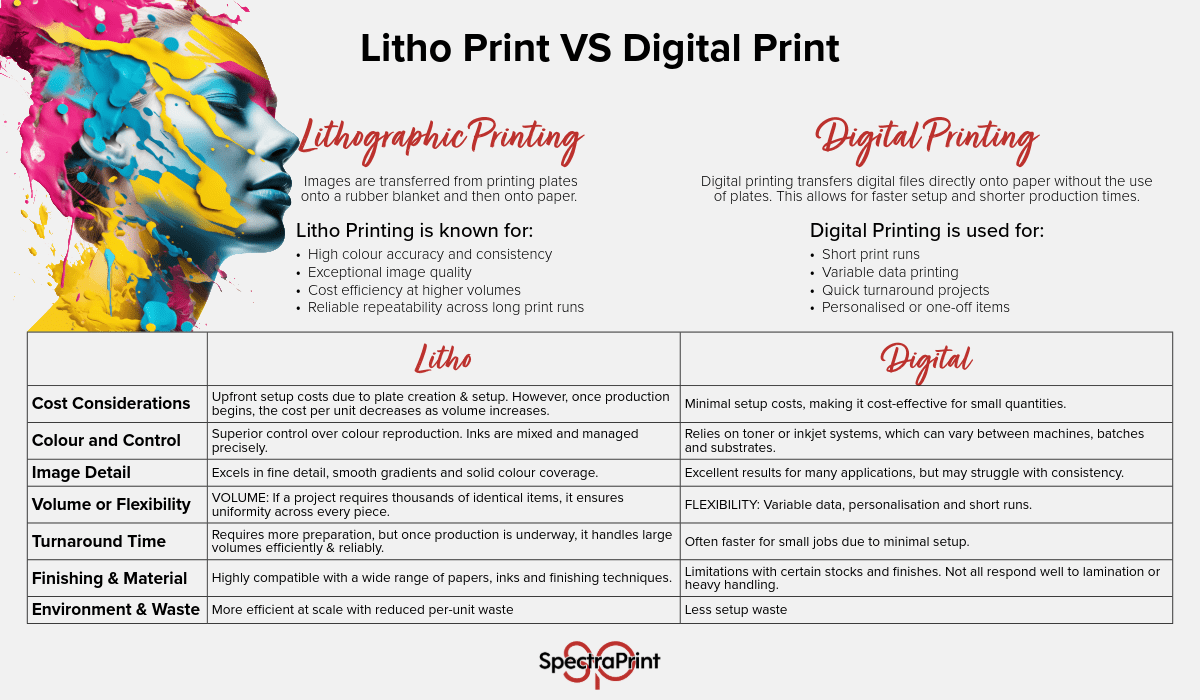
Lithographic printing, commonly referred to as litho, is an offset printing process. Images are transferred from printing plates onto a rubber blanket and then onto paper.
Litho printing is known for:
- High colour accuracy and consistency
- Exceptional image quality
- Cost efficiency at higher volumes
- Reliable repeatability across long print runs
It is widely used for commercial printing, retail point-of-sale material, packaging, posters, folders and corporate stationery.
What is a digital printing method?
Digital printing transfers digital files directly onto paper without the use of plates. This allows for faster setup and shorter production times.
Digital printing is typically chosen for:
- Short print runs
- Variable data printing
- Quick turnaround projects
- Personalised or one-off items
It offers flexibility and speed, particularly when volume is low.
Cost Considerations: Setup vs Scale
Litho printing costs
Litho printing involves upfront setup costs due to plate creation and press setup. However, once production begins, the cost per unit decreases significantly as volume increases.
This makes litho printing financially efficient for medium to large print runs, where consistency and quality are essential.
Digital printing costs
Digital printing has minimal setup costs, making it cost-effective for small quantities. However, the cost per unit remains relatively constant regardless of volume.
As quantities increase, digital printing can become significantly more expensive than litho without delivering the same level of consistency.
Quality and Consistency Differences in printing method
Colour accuracy and control
Litho printing offers superior control over colour reproduction. Inks are mixed and managed precisely, allowing for accurate brand colour matching and consistency across multiple print runs.
Digital printing relies on toner or inkjet systems, which can vary between machines, batches and substrates.
For brand-critical material, consistency is often non-negotiable, making litho the preferred choice.
Image sharpness and detail
Litho printing excels in fine detail, smooth gradients and solid colour coverage. This is particularly important for large-format items and high-impact promotional material.
Digital printing produces excellent results for many applications, but may struggle with consistency on heavier stocks or complex finishes.
Volume and Scalability for printing method
When volume matters
If a project requires thousands of identical items, litho printing is typically the most reliable and cost-effective option. It ensures uniformity across every piece, which is essential for retail and national campaigns.
When flexibility matters
Digital printing allows for easy changes between prints. Variable data, personalisation and short runs are areas where digital printing excels.
The decision comes down to whether the priority is scalability or adaptability.
Turnaround Time and Production Speed
Digital printing is often faster for small jobs due to minimal setup. Files can be processed and printed almost immediately.
Litho printing requires more preparation, but once production is underway, it handles large volumes efficiently and reliably.
Turnaround time should always be considered alongside quality, quantity and budget rather than in isolation.
Finishing and Material Compatibility
Litho printing is highly compatible with a wide range of papers, inks and finishing techniques. This makes it ideal for projects requiring lamination, varnishing, die-cutting or folding.
Digital printing can have limitations with certain stocks and finishes. Not all digitally printed materials respond well to lamination or heavy handling.
Understanding finishing requirements early helps avoid selecting a method that limits post-production options.
Environmental and Waste Considerations
Both methods have environmental considerations. Digital printing produces less setup waste, while litho printing becomes more efficient at scale with reduced per-unit waste.
Responsible printers manage materials carefully, optimise runs and minimise waste regardless of method.
Choosing the Right Method for Your Project
The best printing method depends on several factors:
- Quantity required
- Brand colour accuracy needs
- Paper and finishing requirements
- Budget constraints
- Turnaround expectations
There is no universal answer. The right choice balances technical suitability with business objectives.
Why Guidance Matters
Selecting the wrong print method can lead to higher costs, inconsistent results or reduced lifespan of printed material.
Experienced printers guide clients through these decisions, ensuring the chosen method aligns with the intended use and long-term value of the print.
Print works best when it is planned strategically, not selected by default.
Final Thoughts
Lithographic and digital printing are not competing solutions. They are complementary tools, each designed for specific applications.
Understanding their differences allows businesses to make informed decisions that improve quality, consistency and cost efficiency.
Choosing the right method is not about trends or convenience. It is about using the right tool for the job.
Leave a Reply