

Trust in business is built through repetition. When something performs the same way every time, confidence grows. This principle applies just as strongly to commercial printing as it does to service delivery or product quality.
In commercial environments, printed material is often produced at scale and distributed across multiple locations. Inconsistent colour, quality or finishing immediately erodes credibility and signals a lack of control behind the scenes.
Consistency in printing is not accidental. It is the result of disciplined processes, technical expertise and experience. This article explores why consistency matters in commercial printing and how it directly contributes to trust.
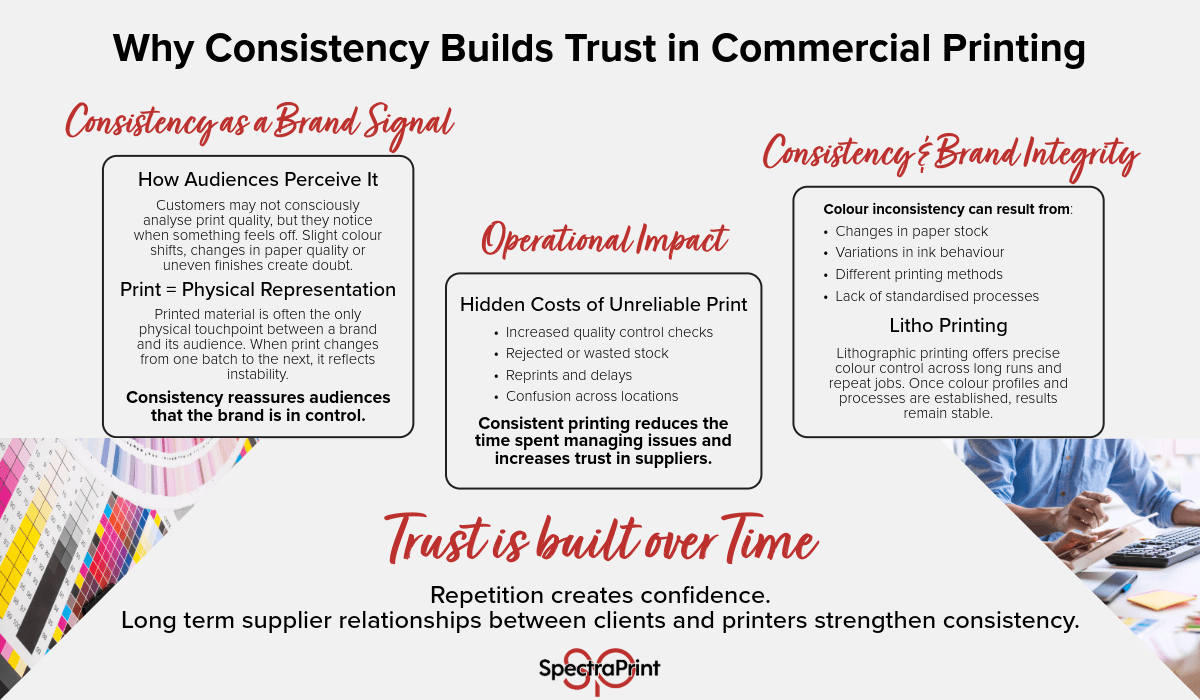
Consistency as a Brand Signal
How audiences perceive consistency
Customers may not consciously analyse print quality, but they notice when something feels off. Slight colour shifts, changes in paper quality or uneven finishes create doubt.
Consistent print communicates:
- Professionalism
- Reliability
- Attention to detail
- Brand maturity
Inconsistency, even when subtle, undermines these signals.
Print as a physical representation of brand
Printed material is often the only physical touchpoint between a brand and its audience. When print changes from one batch to the next, it reflects instability.
Consistency reassures audiences that the brand is in control.
The Operational Impact of Inconsistency
Hidden costs of unreliable print
Inconsistent printing introduces operational friction, including:
- Increased quality control checks
- Rejected or wasted stock
- Reprints and delays
- Confusion across locations
These issues add cost and complexity that rarely appear in the original quote.
Internal confidence matters too
Marketing teams and procurement managers need confidence that materials will arrive as expected. Consistent printing reduces the time spent managing issues and increases trust in suppliers.
Colour Consistency and Brand Integrity
Why colour variation happens
Colour inconsistency can result from:
- Changes in paper stock
- Variations in ink behaviour
- Different printing methods
- Lack of standardised processes
Without tight control, variation is inevitable.
Why lithographic printing excels at consistency
Lithographic printing offers precise colour control across long runs and repeat jobs. Once colour profiles and processes are established, results remain stable.
For brands operating at scale, this consistency is critical.
Consistency Across Multiple Locations
Retail and multi-site challenges
Retail and franchise environments rely heavily on uniform presentation. A poster that looks different from store to store damages brand cohesion.
Consistent printing ensures:
- Uniform brand presence
- Predictable customer experience
- Simplified distribution
When print is reliable, rollout becomes smoother and more efficient.
Trust Is Built Over Time
Repetition creates confidence
Trust is not created by a single successful print job. It is built over repeated interactions where expectations are met consistently.
Reliable print outcomes allow businesses to plan confidently, knowing what they will receive each time.
Long-term supplier relationships
Consistency strengthens relationships between printers and clients. When output is predictable, communication shifts from problem-solving to strategic planning.
This is where real value is created.
Process Discipline Behind the Scenes
Systems that support consistency
Consistent printing relies on:
- Standardised paper and ink specifications
- Documented production processes
- Skilled press operators
- Quality control checks at every stage
These systems require discipline and experience.
Experience still matters
Technology supports consistency, but it does not replace human judgement. Experienced teams recognise potential issues before they affect output.
Consistency is achieved through knowledge, not automation alone.
The Financial Value of Trust
Trust reduces friction. Fewer corrections, fewer reprints and fewer delays lead to lower long-term costs.
Reliable printing also protects brand equity, which has measurable financial value over time.
Consistency is not just a quality issue. It is a business one.
Final Thoughts
In commercial printing, consistency is a promise. It tells clients and customers that what they see today will match what they see tomorrow.
That promise builds trust, strengthens brands and supports long-term success.
Consistency is not created by chance. It is built through experience, process and commitment to doing things properly.
Leave a Reply