

When most people think about printing, they picture the final product: a poster on a wall, packaging on a shelf, or promotional material handed to a customer. What often goes unseen are the decisions made for print before ink ever touches paper.
Paper choice, ink formulation and finishing techniques play a critical role in how print performs. These decisions affect not only appearance, but also durability, readability, cost efficiency and brand consistency.
In commercial and retail environments, print is expected to work hard. It must reproduce colour accurately, withstand handling, display well under lighting and remain consistent across reprints. Achieving this is not accidental. It is the result of informed technical decisions made early in the process.
This article breaks down how paper, ink and finishing choices influence print performance, and why understanding these fundamentals leads to better outcomes.
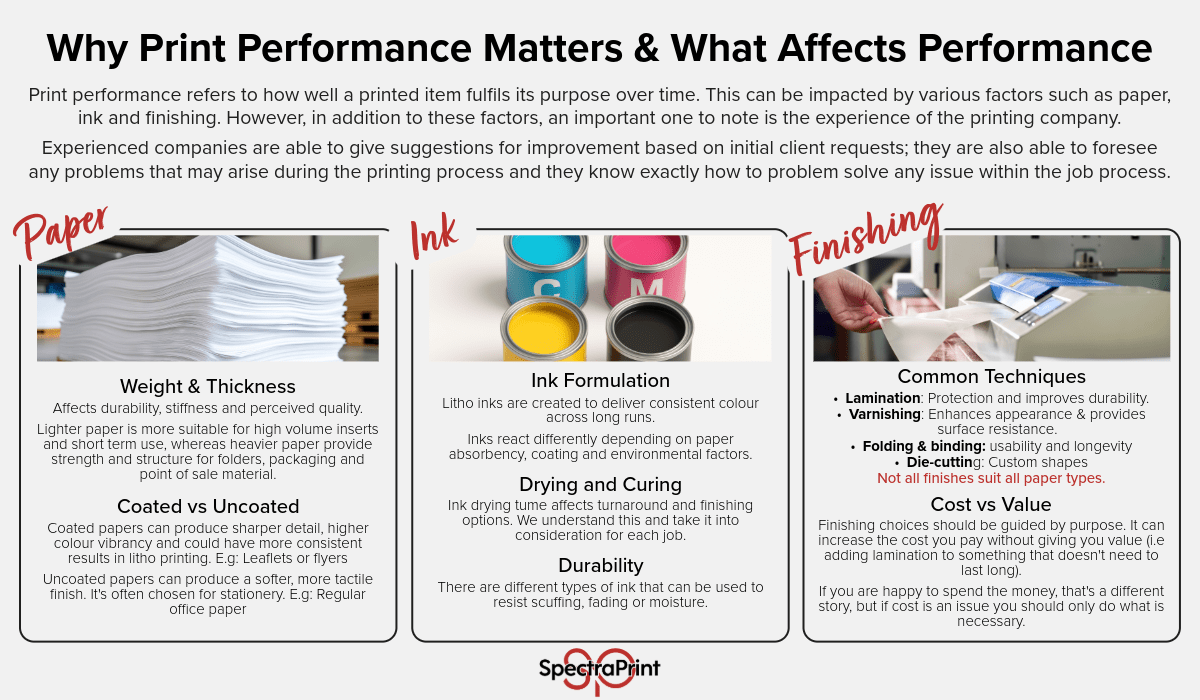
Why Print Performance Matters
Print performance refers to how well a printed item fulfils its purpose over time. This includes:
- Visual clarity and colour accuracy
- Structural integrity and durability
- Consistency across large print runs
- Suitability for handling, transport and display
- Cost effectiveness over the full production lifecycle
A visually impressive print that scuffs easily, curls under lighting, or varies from batch to batch does not perform well. Strong print performance aligns technical decisions with the real-world environment the product will be used in.
Paper: The Foundation of Every Print Job
Paper is not simply a surface for ink. It is the foundation that determines how ink behaves, how colours appear, and how the finished product feels in hand.
Paper weight and thickness
Paper weight, often measured in grams per square metre (gsm), affects stiffness, durability and perceived quality.
- Lighter stocks are suitable for high-volume inserts and short-term use
- Heavier stocks provide strength and structure for folders, packaging and point-of-sale material
Choosing the correct weight ensures the print holds its shape and performs as intended.
Coated vs uncoated paper
Coated papers have a smooth surface that allows ink to sit on top rather than absorb fully. This results in:
- Sharper detail
- Higher colour vibrancy
- More consistent results in lithographic printing
Uncoated papers absorb more ink, producing a softer, more tactile finish. They are often chosen for stationery or applications where a natural feel is preferred.
The choice depends on function, not preference alone. A high-gloss coated stock may look impressive, but it is not always suitable for writable or high-handling applications.
Paper grain direction
Grain direction influences how paper folds, creases and feeds through presses. Ignoring grain direction can lead to cracking, curling or uneven folds, particularly on heavier stocks.
Experienced printers account for grain direction early in planning, preventing issues that only become visible after finishing.
Ink: More Than Just Colour
Ink selection has a direct impact on colour consistency, drying time, durability and compatibility with paper.
Ink formulation and colour accuracy
Lithographic inks are carefully formulated to deliver consistent colour across long runs. This is essential for brand-critical material where colour deviation is unacceptable.
Inks behave differently depending on paper absorbency, coating and environmental conditions. Understanding this interaction allows for accurate colour reproduction and repeatability.
Drying and curing considerations
Ink drying time affects turnaround, finishing options and stacking. Certain paper and ink combinations require longer drying times to avoid smudging or set-off.
A knowledgeable printer anticipates these factors and adjusts production schedules accordingly.
Durability and resistance
Some applications require inks that resist scuffing, fading or moisture. This is particularly relevant for point-of-sale material, packaging and items exposed to frequent handling.
Ink choice must align with how and where the printed product will be used.
Finishing: Where Function Meets Presentation
Finishing is often seen as decorative, but it plays a critical functional role in print performance.
Common finishing techniques
- Lamination adds protection and improves durability
- Varnishing enhances appearance and provides surface resistance
- Folding and binding determine usability and longevity
- Die-cutting allows for custom shapes but requires precise planning
Each finishing option affects how print holds up in real-world conditions.
Finishing and paper compatibility
Not all finishes suit all paper types. Lamination behaves differently on textured stocks than on smooth coated paper. Incorrect combinations can result in bubbling, peeling or cracking.
Understanding these interactions prevents costly rework and ensures a professional result.
Cost vs value considerations
Finishing choices should be guided by purpose. Over-finishing increases cost without adding performance, while under-finishing can shorten the lifespan of printed material.
The goal is not to add more, but to add what is necessary.
How These Decisions Affect Consistency
Consistency is a key marker of quality in commercial printing. It builds trust and reinforces brand integrity.
Paper variations, ink behaviour and finishing tolerances all influence consistency across reprints. When these elements are standardised and documented, repeat jobs deliver predictable results.
This is particularly important for retailers and national brands that require uniformity across multiple locations and campaigns.
The Role of Experience in Print Decision-Making
While technology plays a significant role in modern printing, experience remains critical. Many print performance issues only reveal themselves after years of hands-on production.
An experienced printer understands:
- How subtle paper changes affect ink absorption
- Which finishing techniques perform best in specific environments
- How to balance cost, durability and appearance
This knowledge allows potential issues to be identified and addressed before production begins.
Making Better Print Decisions
Strong print performance does not come from isolated choices. It comes from understanding how paper, ink and finishing interact as a system.
Businesses that take time to understand these fundamentals benefit from:
- More reliable outcomes
- Fewer production issues
- Better value over time
- Stronger brand presentation
Print is not just a visual medium. It is a physical one, and physical performance matters.
Final Thoughts
Every successful print job begins with informed decisions. Paper, ink and finishing are not technical afterthoughts. They are the building blocks of print performance.
When these elements are chosen with purpose and expertise, printed material does more than look good. It performs consistently, lasts longer and delivers real value.
Spectraprint assists all customers when it comes to choosing the right paper, ink and finish for your print jobs.
That is the difference between printing something, and printing it properly.
If you’d like to read more about the type of printing Spectraprint does, click here for our article on “Understanding Lithographic Printing“.
Leave a Reply